From Independence to Expansion and Back Again
The Mexican–American War, 1846–1848
After the United States annexed Texas in 1845, border disputes led to war with Mexico in 1846.
Learning Objectives
Identify the causes of the Mexican–American War
Key Takeaways
Key Points
- Conflict with Mexico began when the United States annexed Texas as a state in 1845.
- United mexican states claimed that the new border between Texas and Mexico was the Nueces River, while the United States contested the border was the Rio Grande.
- Fighting began when a detachment of U.S. cavalry was attacked most the Rio Grande.
- Zachary Taylor and Winfield Scott led armies to a series of military successes that culminated in the capture of Mexico Urban center in 1847.
Key Terms
- Treaties of Velasco: Documents signed in Texas on May fourteen, 1836, intended to conclude the hostilities betwixt Texas and Mexico and recognize Texas' independence; however, United mexican states never ratified them.
- annexation: The permanent acquisition and incorporation of a territorial entity into some other geo-political entity (either adjacent or non-contiguous).
Background
The Mexican–American War was an armed conflict between the United States and Mexico that took place in 1846–1848. Information technology occurred in the wake of the 1845 U.S. annexation of Texas, which Mexico considered office of its territory despite the 1836 Texas Revolution in which the Democracy of Texas claimed its independence.
The border of Texas as an independent land had never been settled. The Republic of Texas claimed land up to the Rio Grande, based on the Treaties of Velasco. However, Mexico refused to have these as valid, claiming the border was the Nueces River. U.S. President James Polk endorsed the Rio Grande purlieus, which incited a dispute with Mexico.
Later a series of failed negotiations with Mexico Metropolis, Polk ordered General Zachary Taylor and his forces s to the Rio Grande to enter the territory that Mexicans disputed. On Apr 25, 1846, a Mexican cavalry detachment routed the patrol, killing sixteen U.Due south. soldiers. In response, Polk asked for a declaration of war. Congress declared state of war on United mexican states on May 13, 1846, later only a few hours of debate.
The War
The Us armed forces strategy had three main objectives: ane) Take control of northern United mexican states, including New United mexican states; 2) seize California; and 3) capture Mexico City. The US State of war Section sent a cavalry force under General Stephen Due west. Kearny to invade western Mexico from Jefferson Barracks and Fort Leavenworth, reinforced by a Pacific fleet under John D. Sloat. This was done primarily because of concerns that U.k. might also effort to seize the area. Ii more forces, one under John E. Wool and the other under Taylor, were ordered to occupy Mexico as far south as the urban center of Monterrey.
California, Kearny, and Sloat
United states Ground forces Captain John C. Frémont entered California in December 1845 and was slowly marching to Oregon when he received discussion that war betwixt United mexican states and the United States was imminent. On June fifteen, 1846, some 30 settlers staged a revolt and seized the small Mexican garrison in Sonoma, California. The democracy was in existence scarcely more than than a week earlier the U.S. Army, led past Frémont, took over on June 23.
Commodore John Drake Sloat, upon hearing of imminent war and the defection in Sonoma, ordered his naval and marine forces to occupy Monterrey on July 7. On July 15, Sloat transferred his command to Commodore Robert F. Stockton who put Frémont'due south forces under his orders. On July 19, upon receiving official word of the start of war, Frémont's so-called California Battalion entered Monterrey in a joint operation with some of Stockton'due south sailors and marines. The U.S. forces easily took over the north of California.
From Alta California, Mexican General José Castro and Governor Pío Pico fled south. When Stockton's forces stopped in San Pedro, Stockton sent 50 U.S. Marines ashore. This forcefulness entered Los Angeles unresisted on August xiii, 1846. With the success of this "Siege of Los Angeles," the most bloodless conquest of California seemed consummate.
Meanwhile, General Kearny's forces fought in the decisive Battle of Rio San Gabriel. The next day, January ix, 1847, the Americans fought and won the Battle of La Mesa. On Jan 12, the concluding meaning body of Californios surrendered to U.Southward. forces. That marked the end of armed resistance in California, and the Treaty of Cahuenga was signed the next twenty-four hours, on January thirteen, 1847.
Taylor and Scott'southward Legacies
Led past Taylor, 2,300 U.Southward. troops crossed the Rio Grande and headed toward the besieged metropolis of Monterrey. The difficult-fought Battle of Monterrey resulted in serious losses on both sides. U.S. soldiers were introduced to urban warfare for the first time and had to arrange their battle tactics appropriately. The Mexican forces under General Pedro de Ampudia eventually surrendered.

Battle of Monterrey: General Zachary Taylor and the US army defeated the Mexican ground forces during the Battle of Monterrey, lasting September 21–24, 1846.
On February 22, 1847, Santa Anna personally marched n to fight Taylor in the Battle of Buena Vista. Furious fighting ensued, during which the U.S. troops were near defeated but managed to cling to their entrenched position. Rather than reinforce Taylor's army for a continued advance, Polk sent a 2nd regular army under General Winfield Scott to begin an invasion of the Mexican heartland.
On March nine, 1847, Scott performed the kickoff major amphibious landing in U.S. history in preparation for the Siege of Veracruz. Meanwhile, mortars and naval guns reduced the city walls. The effect of the extended barrage destroyed the volition of the Mexican side to fight, and they surrendered the metropolis subsequently 12 days under siege.
Scott then avant-garde on United mexican states City on August 7. The capital was laid open in a series of battles, culminating in the Battle of Chapultepec. On September fourteen, 1847, When Scott entered Mexico Urban center's central plaza the city had fallen. While Polk and other expansionists called for "all United mexican states," the Mexican government and the United States negotiated for peace in 1848, resulting in the Treaty of Guadalupe Hidalgo.
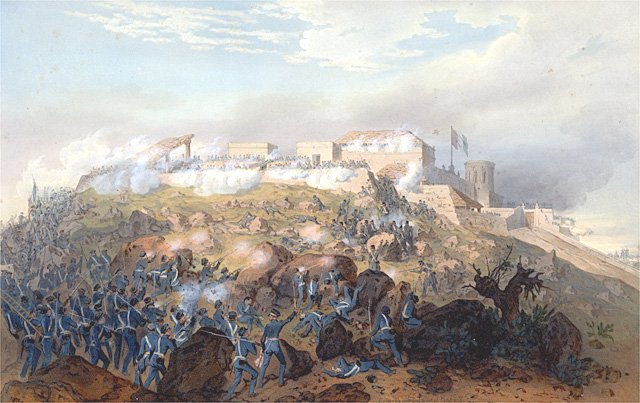
Battle of Chapultapec: U.South. forces began their set on on Chapultapec, the main fort protecting Mexico City, on September 12, 1847, with an arms barrage.
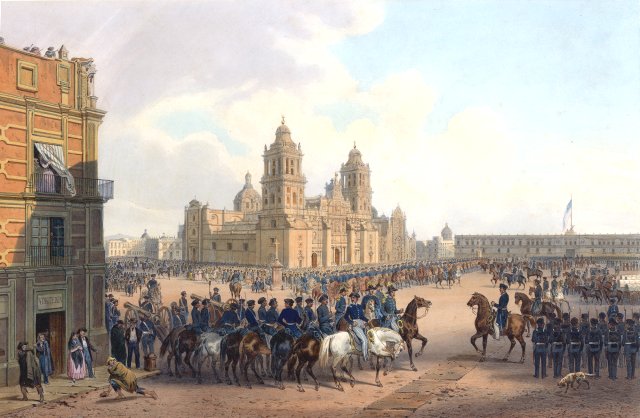
U.Southward. Occupation of United mexican states City: This 1851 painting past Carl Nebel shows the U.S. occupation of Mexico City, which began afterward US forces captured the city in September 1847.
Treaty of Guadalupe Hidalgo
The Treaty of Guadalupe Hidalgo, signed in February 1848, was a triumph for U.Due south. expansionism under which United mexican states ceded virtually half its land. The Mexican Cession, as the conquest of country west of the Rio Grande was called, included the current states of California, New Mexico, Arizona, Nevada, Utah, and portions of Colorado and Wyoming. Mexico likewise came to recognize the Rio Grande equally the edge with the U.s.a.. Mexican citizens in the ceded territory were promised U.S. citizenship in the futurity when the territories they were living in became states. In substitution, the The states agreed to presume $3.35 one thousand thousand worth of Mexican debts owed to U.Due south. citizens, paid Mexico $xv meg for the loss of its land, and promised to baby-sit the residents of the Mexican Cession from American Indian raids.
Victory in Mexico
American victory in the Mexican–American war yielded huge acquisition of land and increased domestic tensions over slavery.
Learning Objectives
Identify the territories that the United States acquired at the cease of the Mexican–American War
Central Takeaways
Key Points
- Afterwards the U.S. army occupied Mexico City, the Treaty of Guadalupe Hidalgo was negotiated and brought the state of war to an stop. The treaty gave the The states command of Texas, established the border at the Rio Grande, and ceded other Mexican lands to the The states in the southwest.
- In render, Mexico received $18,250,000—less than one-half the corporeality the United States tried to offering for the land before the opening of hostilities.
- In the United States, increasingly divided past sectional rivalry, the war was a partisan effect and an essential element in the origins of the American Civil State of war. Most Whigs in the North and South opposed it, while most Democrats supported it.
- Southern Democrats, blithe by a popular belief in manifest destiny, supported the war in hopes of adding slave-owning territory to the Southward and fugitive being outnumbered past the faster-growing North.
- Northern antislavery elements feared the rise of a slave power; Whigs generally wanted to strengthen the economy with industrialization, not expand it with more than country.
- The war was one of the most decisive events for the United States in the first half of the 19th century, serving as a milestone specially within the U.South. narrative of manifest destiny.
Key Terms
- Treaty of Guadalupe Hidalgo: The peace accord, largely dictated by the United States to the interim government of a militarily occupied United mexican states City, and that concluded the Mexican–American War (1846–1848) on February 2, 1848.
- Rio Grande: A river that flows from southwestern Colorado in the The states to the Gulf of Mexico.
- Mexican Cession: A historical name for the region of the present twenty-four hours southwestern United states that was acquired in the Treaty of Guadalupe Hidalgo.
Treaty of Guadalupe Hidalgo
Outnumbered militarily, and with many of its large cities occupied, Mexico could not defend itself and was also faced with internal divisions. It had piffling choice but to make peace on any terms. The Treaty of Guadalupe Hidalgo was signed on February 2, 1848, by U.Due south. diplomat Nicholas Trist and Mexican plenipotentiary representatives Luis G. Cuevas, Bernardo Couto, and Miguel Atristain.
The treaty ended the war and gave the United states of america undisputed control of Texas, established the U.Due south.–Mexican border as the Rio Grande River, and ceded to the United states of america the present-day states of California, Nevada, Utah, New United mexican states, about of Arizona and Colorado, and parts of Texas, Oklahoma, Kansas, and Wyoming. In return, Mexico received $xviii,250,000—less than one-half the amount the United States had attempted to offering for the land before the opening of hostilities—and the United States agreed to assume $3.25 million in debts that the Mexican government owed to U.Due south. citizens.
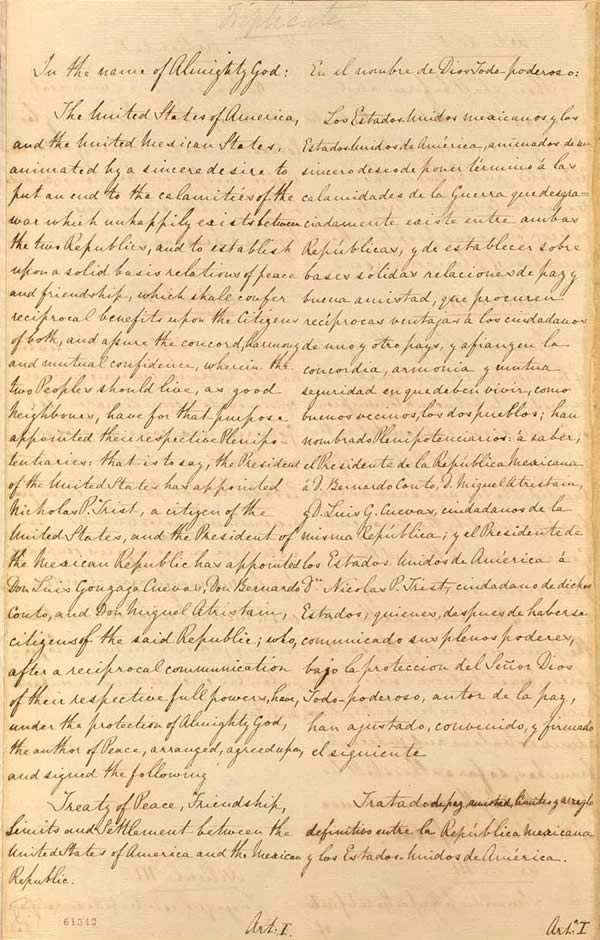
Treaty of Guadalupe Hidalgo: The showtime page of the handwritten Treaty of Guadalupe Hidalgo, which ended the Mexican–American War.
Opposition to the Acquisition
The acquisition was a source of controversy, especially among U.Due south. politicians who had opposed the war from the outset. In the United States, increasingly divided by sectional rivalry, the war was a partisan issue and an essential element in the origins of the American Civil War. Most Whigs in the N and South opposed it, while well-nigh Democrats supported it. Southern Democrats, animated by a popular belief in manifest destiny, supported it in the hopes of adding slave-owning territory to the South and avoiding being outnumbered by the faster-growing North.
Northern antislavery elements feared the rising of a slave power; Whigs generally wanted to strengthen the economy with industrialization, not expand it with more country. John Quincy Adams in Massachusetts argued that the war with Mexico would add new slavery territory to the nation. Northern abolitionists attacked the war as an endeavor by slave-owners to strengthen the grip of slavery and thus ensure their continued influence in the federal government. Democratic Congressman David Wilmot introduced the Wilmot Proviso, which aimed to prohibit slavery in new territory caused from United mexican states. Wilmot's proposal did not pass Congress, but it spurred further hostility between the factions.
Those who advocated for the war, in dissimilarity, viewed the territories of New Mexico and California as only nominally Mexican possessions with very tenuous ties to Mexico. They saw the territories as actually unsettled (despite their large populations of American Indians), ungoverned, and unprotected borderland lands. The non-indigenous population there, where there was whatever at all, represented a substantial—in places fifty-fifty a majority—Anglo-American component. Moreover, the territories were feared to be nether imminent threat of acquisition by the United States' rival, the British.
Touch of the War
Manifest Destiny
The acquired lands west of the Rio Grande are traditionally chosen the Mexican Cession in the Us, every bit opposed to the Texas Annexation ii years earlier. Mexico never recognized the independence of Texas prior to the state of war, and did not cede its claim to territory north of the Rio Grande or Gila River until this treaty.
While the Mexican–American War marked a significant point for the nation as a growing military power, it also served as a milestone particularly within the U.S. narrative of manifest destiny. The resultant territorial gains prepare in motion many of the defining trends in U.South. 19th-century history, especially for the American West. In doing much to extend the nation from coast to declension, the Mexican–American War was i step in the massive westward migrations of Americans, which culminated in transcontinental railroads and the Indian wars later in the same century.
The Politics of Slavery
The 1848 treaty with United mexican states was one of the most decisive events for the United states. in the first half of the 19th century. However, information technology did not bring the Usa domestic peace. Instead, the conquering of new territory revived and intensified the debate over the futurity of slavery in the western territories, widening the growing division betwixt the North and South and leading to the creation of new single-issue parties. Westward expansion of the institution of slavery took an increasingly central and heated theme in national debates preceding the American Civil State of war. Increasingly, the South came to regard itself as under attack past radical northern abolitionists, and many northerners began to speak ominously of a southern drive to dominate U.Southward. politics for the purpose of protecting slaveholders' human belongings. As tensions mounted and both sides hurled accusations, national unity frayed. Compromise became nearly impossible and antagonistic sectional rivalries replaced the idea of a unified, democratic democracy.
The proposition that slavery be barred from the Mexican Cession caused a split inside the Autonomous Party. The 1840s were a particularly active fourth dimension in the cosmos and reorganization of political parties and constituencies, mainly because of discontent with the positions of the mainstream Whig and Autonomous parties in regard to slavery and its extension into the territories. The beginning new political party was the small-scale and politically weak Liberty Party, founded in 1840. This was a single-issue party made up of abolitionists who fervently believed slavery was evil and should be concluded, and that this was best achieved by political means. In 1848, many northern Democrats united with anti-slavery Whigs and former members of the Liberty Political party to create the Free-Soil Party. The party took as its slogan "Free Soil, Free Oral communication, Free Labor, and Free Men," and had one real goal—oppose extension of slavery into the territories.
The California Gold Blitz
The discovery of gilt in California in 1848 sent hundreds of thousands of people West in search of fortunes.
Learning Objectives
Examine the demographics of the population that participated in the California Gilded Rush
Key Takeaways
Primal Points
- The California Gold Rush began on Jan 24, 1848, when James West. Marshall found gold at Sutter's Manufacturing plant in Coloma, California.
- The gilded-seekers, known as "twoscore-niners" (in reference to the yr 1849), came from across the United States too as from Latin America, Europe, Australia, and China.
- Although $550 meg worth of gold was found in California between 1849 and 1850, very picayune of it went to individuals.
- Gold was offset gathered using unproblematic techniques such as panning, simply as more people arrived, more expensive infrastructure was needed for mining.
- As people flocked to California in 1849, the population of the new territory swelled from a few thousand to about 100,000, and boom towns like San Francisco formed nearly overnight.
- The Gilt Rush also had significantly negative effects on American Indians in the area, who were attacked and pushed off their lands.
Fundamental Terms
- smash boondocks: A community that experiences sudden and rapid growth.
- panning: A class of traditional mining that extracts gold from a placer deposit.
- forty-niner: A miner who took part in the California Gold Rush of the mid-19th century.
Seeking Fortune in the West
The California Golden Rush began on January 24, 1848, when James W. Marshall plant aureate at Sutter'southward Mill in Coloma, California. The first people to hear confirmed data of the gilt blitz were in Oregon, the Sandwich Islands (Hawaii), and Latin America, and were the first to start flocking to the land in late 1848. The news of gold eventually brought some 300,000 people to California from the balance of the U.s. and abroad. Approximately half of those arrived by ocean, while one-half came from the east overland on the California Trail and the Gila River Trail.
The gold-seekers, known as "forty-niners" (in reference to the year 1849), often faced substantial hardships on their trip. While well-nigh of the newly arrived were Americans, the Gold Rush attracted tens of thousands from Latin America, Europe, Australia, and Communist china. At first, the gold nuggets could be picked upwards off the ground. Later, gold was recovered from streams and riverbeds using simple techniques, such as panning. More than sophisticated methods were adult and afterwards adopted elsewhere. At its peak, technological advances reached a point where significant financing was required, decreasing the ratio of individual miners to golden companies. Although $550 1000000 worth of gilded was found in California between 1849 and 1850, very little of it went to individuals. While it led to not bad wealth for a few, many returned home with little more than they had when they started.
Effects of the Gilded Rush
The furnishings of the Gold Rush were substantial. As people flocked to California in 1849, the population of the new territory swelled from a few thousand to about 100,000. San Francisco grew from a pocket-size settlement of almost 200 residents in 1846 to a boomtown of nigh 36,000 by 1852. Roads, churches, schools, and new towns were built throughout California. The new arrivals quickly organized themselves into communities, and the trappings of "civilized" life—stores, saloons, libraries, stagelines, and congenial lodges—began to appear. Newspapers were established, and musicians, singers, and acting companies arrived to entertain the gold-seekers. In 1849 a state constitution was written, a governor and legislature called, and California became a state every bit role of the Compromise of 1850.
New methods of transportation developed as steamships came into regular service. Past 1869, railroads were built across the country from California to the eastern United States. Agriculture and ranching expanded throughout the state to meet the needs of the settler-invaders. At the beginning of the Golden Rush, in that location was no constabulary regarding property rights in the goldfields, and a system of "staking claims" was subsequently developed.
The Gold Blitz also had significantly negative effects on American Indians in the expanse, who were attacked and pushed off their lands. Observers in the gold fields reported abuse of American Indians by miners. Some miners forced American Indians to work their claims for them, while others drove them off their lands, stole from them, and even murdered them. Not-Americans were generally disliked, especially those from South America. The most despised, however, were the thousands of Chinese migrants. Eager to earn money to transport to their families in Hong Kong and southern China, they speedily earned a reputation equally frugal men and difficult workers who routinely took over diggings others had abased as worthless and worked them until every scrap of gilded had been establish. Many American miners, ofttimes spendthrifts, resented their presence and discriminated against them, believing the Chinese, who represented about 8% of the virtually 300,000 who arrived, were depriving them of the opportunity to brand a living.
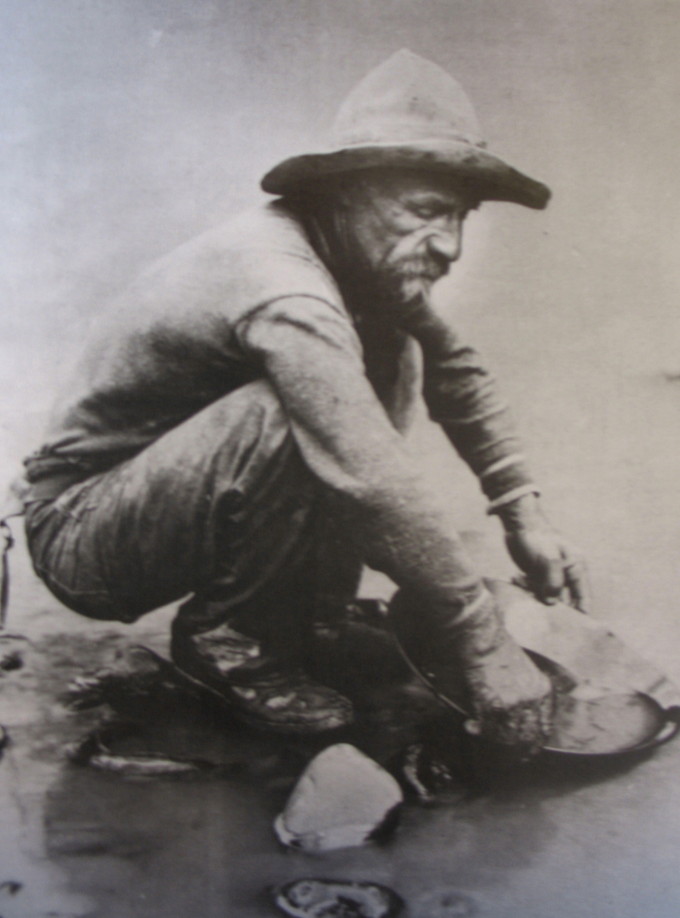
Xl-Niner: A forty-niner, then chosen because he came to California in 1849, pans for gilded.
giordanomalley1969.blogspot.com
Source: https://courses.lumenlearning.com/boundless-ushistory/chapter/expansion-and-the-mexican-american-war/
0 Response to "From Independence to Expansion and Back Again"
Post a Comment